
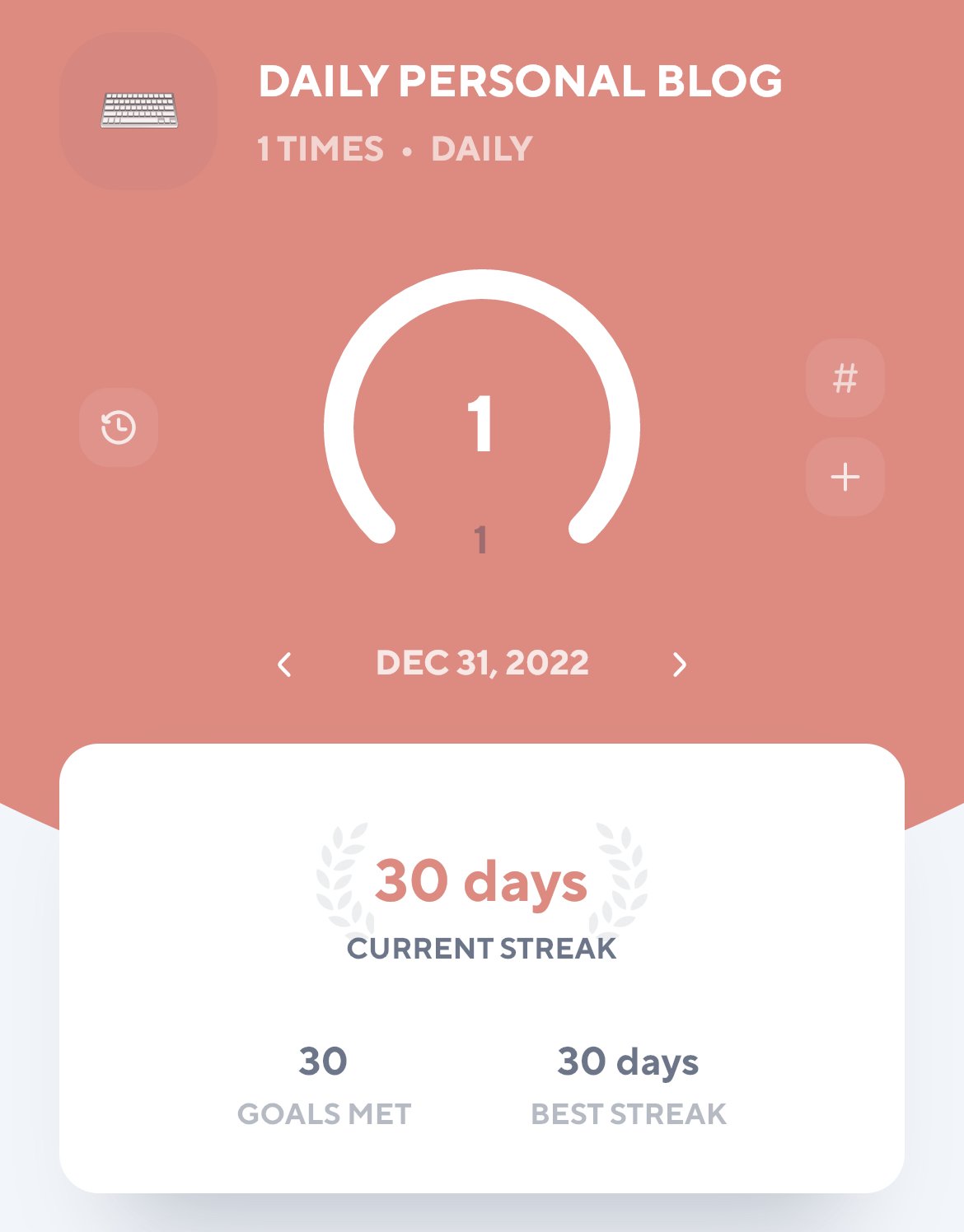
Reflecting on 30 days of blogging
I hit the 30 day streak of daily blogging!
Some thoughts:
It was mostly easier than I thought. Before I knew it, I was on day 28 and 29.
The pressure to blog daily forced me to phone it in a few days. I would say that the quality wasn’t there all the time, but maybe that’s a good thing. I found in the past that thinking every post needed to be epic stopped me from posting at all.
I’m not sure if I want to continue to post everyday But I like the idea of writing something everyday, but posting when something is ready.

Day 17
I passed the half-way point of my 30-day daily blogging challenge.
When I first started Obsessed it felt daunting thinking about carving out time to write and fill up my blog.
Daily blogging has been a great reminder to focus on the system rather than the outcome.
A blog filled with post will take care of itself if I’m blogging daily.
I already have 17 more post than I did when I started!
This is something I’m trying to apply in other areas of my life, like drawing and my health routine.

Some thoughts on Ai art
There’s a lot of talk right now about Ai generated art and what it means for creators.
Personally, I don’t believe all the doom and gloom.
Some thoughts:
Creators adapt
Creators have always adapted to technology. We’ve gone from dark rooms to Adobe Lightroom. Musicians skip the gatekeepers and make a living without record labels thanks to streaming.
Leave it to creators to find creative solutions.

‘Humanmade’ will become a selling point
‘Handmade’ has always been regarded as a mark of luxury in fashion. I suspect we will start seeing a variation of this for artists and writers as AI generated work improves.
'Humanmade' will be the new 'Handmade'.
Ai will make a lot of things easier to do, making the old ways a lot more valuable.
We admire mastery and craftsmanship. We value people that choose to do things the hard way because we understand that it’s earned. Choose constant mastery and you have nothing to worry about.
Showing your work process becomes part of the marketing
Austin Kleon’s argument for showing your work and process should become a marketing tool for creators. Not only to “prove” the human made aspect, but, as Austin argues:
“Human beings want to know where things came from, how they were made, and who made them. The stories you tell about the work you do have a huge effect on how people feel and what they understand about your work, and how people feel and what they understand about your work effects how they value it.”

The dream work studio

Austin Kleon’s new work studio
Ever since Austin Kleon shared completing his dream studio, I've been fantasizing about mine.
For New York artists, a stand-alone studio is the holy grail, only surpassed by an apartment with an in-unit washer/dryer and no roommates.


Yves Saint Laurent’s studio space
I’ve attempted to keep a studio space a few times in NYC. (One in Dumbo, and a sublet one in Gowanus.) Both didn’t last very long.
Too inconvenient of a trek. I also had no idea what I wanted to use the space for! So I ended up using it less and less with each passing week.
And in the case of the Gowanus studio, there were no windows. It was extra depressing to work from during NYC winters.
I’m practicing my art again. And my dream of owning a standalone studio space is closer as I reach more financial goals.

Jenna Lyon’s studio when she worked at J.Crew
A few rules for my future dream studio:
Walkable distance - I’ve learned my lesson from my 2 studios in NYC. The more inconvenience the less likely I’m going to use it.
Separate from where I live - There still needs to be some distance between my home and the studio. I’m finding that physical boundaries helps me maintain psychological boundaries between me and my work.
Must have windows - No brainer.
Long tables, ideally adjustable - I always loved the standing height tables we had when I was studying at Parsons. They’re great for long sessions so you’re not hunched over all the time.
Separate digital and analog spaces - I’m stealing this from Austin Kleon:
“I have two desks in my office — one’s “analog” and one’s “digital.” The analog desk has nothing but markers, pens, pencils, paper, and newspaper. Nothing electronic is allowed on the desk — this is how I keep myself off Twitter, etc. This is where most of my work is born. The digital desk has my laptop, my monitor, my scanner, my Wacom tablet, and a MIDI keyboard controller for if I want to record any music. (Like a lot of writers, I’m a wannabe musician.) This is where I edit, publish, etc.”Enough storage so nothing is left out - This has less to do with wanting to make things look pristine all the time. I think there’s some magic in the chaos of most work/art studios. But I’d like to be able to have things organized so this time around so I can find everything I need.
I love this architects use of rolling tool chests to organize things. A bit industrial, but something I’d totally consider.

Casey Neistat’s NYC work studio.
A bit too industrial for me, but I’m envious of the dedicated space to create.
As for what it might look like, I’ll have to save that for a future post.